
Our history
Origins of the BNA
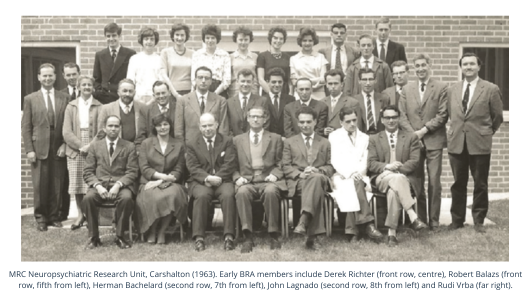
The British Neuroscience Association (formerly known as the ‘Brain Research Association’) was founded in London in 1968 with the aim of drawing knowledge from several distinct scientific disciplines and promoting collaboration across the brain sciences.
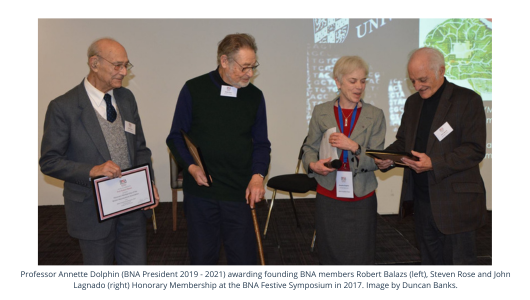
Our members, past and present, include world-leading scientists making major discoveries in neuroscience. The Association has been supported and led by internationally renowned scientists including Horace Barlow, John O’Keefe, and Colin Blakemore, whose discoveries have fundamentally advanced our understanding of brain function.
Starting as an eclectic group of like-minded scientists (initiated by Steven Rose, John Lagnado, John Dobbing, and Robert Balázs), the Brain Research Association would gather at the Black Horse pub in Rathbone Place, London to work together to promote neuroscience in the UK.
Throughout the following decades, the Association played an important role in shaping the UK neuroscience landscape. From organising conferences and workshops to promoting new courses, degrees, research centres and academic chairs, the BNA helped to establish neuroscience as a thriving, interdisciplinary discipline. It also acted as a collective voice for the field, engaging with emerging ethical and societal questions as brain research developed and expanded.

Growing with neuroscience
In recognition of the evolving scope and identity of the field, members voted in 1996 to rename the 'Brain Research Association' to the 'British Neuroscience Association' (BNA). Today, the BNA are proud to be the largest UK organisation connecting, representing and promoting neuroscience and neuroscientists across the globe. Building on a legacy shaped by world leading scientists, the BNA continues to champion collaboration, support researchers at every career stage and promote excellence in neuroscience, from the laboratory to society.
Notable figures in the BNA history
Throughout our history, the BNA has been shaped by the involvement of many highly influential neuroscientists whose work has had lasting impact on the field.
Early contributors included figures such as Patrick Wall, Edward George Gray, Oliver Zangwill, John Cavanagh and Steven Rose, whose research helped establish neuroscience as a distinct and interdisciplinary discipline in the UK.
The Association has since been led by internationally renowned scientists including Horace Barlow, John O’Keefe, and Colin Blakemore, whose discoveries have fundamentally advanced our understanding of brain function.
In more recent decades, prominent neuroscientists such as Trevor Robbins, David Nutt, Russell Foster, Irene Tracey, Anne Lingford-Hughes, Rik Henson and Tara Spires-Jones have played key roles within the BNA, contributing scientific leadership across areas spanning cognition, mental health, sleep, neuroimaging and neurodegeneration. Together, these individuals reflect the breadth, excellence and continued evolution of the neuroscience community represented by the BNA.
The PDFs below recognise the individuals who have shaped the British Neuroscience Association over the years, representing a remarkable breadth of leadership and scientific contribution.
The first & largest organisation of its kind, the BNA is central to UK neuroscience.
Studying the brain is endlessly fascinating and it’s relevant to everyone.
It has never been more important to highlight the strengths of British neuroscience and celebrate its successes.
Papers and Articles
The BNA is committed to preserving the history of neuroscience in the UK. Through its archives, publications and historical reflections, the Association documents the people, ideas and debates that have shaped the field, providing a valuable resource for researchers and historians alike.
The origins of the BNA lie in the 1960s, when neuroscience first emerged as a discipline in its own right. The exact nature and series of events that led to (what was then) to the Brain Research Association are a subject of some discussion, as becomes clear by reading the articles below.
The Legend of the Black Horse, by Joelle M. Abi-Rached, Anne Cooke and Steven Rose
British Neuroscience Association Bulletin, 63 pp 20-21 (2011)
The Legend of the Black Horse (revisited) by Robert Balazs & Edward H. Reynolds
British Neuroscience Association Bulletin, 70 p28 (2014)
Reply to the Legend of the Black Horse (revisited) by Abi-Rached, JM, SPR Rose, and J Lagnado
British Neuroscience Association Bulletin, 70 p29 (2014)
From brain to neuro: the Brain Research Association and the making of British neuroscience 1965–1996, by JM Abi-Rached
J Hist Neurosci, 21 (2012), pp. 189–213
DOI: 10.1080/0964704X.2011.552413
Letter to the Editor and Authors' Response: Reaction to Abi-Rached JM (2012): From Brain to Neuro: The Brain Research Association and the Making of British Neuroscience, 1965–1996. Journal of the History of the Neurosciences 21:189–213) by Robert Balazs & Edward H. Reynolds
J Hist Neurosci, 22 (2013), pp. 199-207
DOI: 10.1080/0964704X.2012.750700
Authors' Response: Of Founding Fathers and History by Joelle M. Abi-Rached & Steven P.R. Rose
J Hist Neurosci, 22 (2013), pp. 208-211
DOI: 10.1080/0964704X.2012.754270
50 years of neuroscience, by Steven Rose
The Lancet, Volume 385, Issue 9968, 14–20 February 2015, Pages 598–599
DOI: 10.1016/S0140-6736(15)60224-0
The origins of the British Neuroscience Association by E. Reynolds
Neuroscience 367, pp. 10–14. (2017)
doi: 10.1016/J.NEUROSCIENCE.2017.09.057