
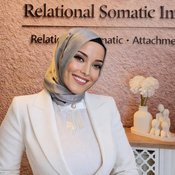
Mrs Betul Rumeysa Demirors
- Phone
- +447593726059
- Job title
- Psychotherapist | Neuroscience-Informed Trauma & Attachment Practitioner | Founder of Relational Somatic Integration™
About Betul Rumeysa
<p>Betul Rumeysa Demirors, MSc, is a psychologist, psychotherapist and researcher based in London, working at the intersection of developmental trauma, attachment, nervous system regulation and neuroscience-informed psychotherapy. Her clinical and academic work focuses on how early relational experiences shape stress regulation, attachment patterns, self-development, psychological resilience and long-term mental health across the lifespan. She has a particular interest in the psychobiological impact of relational safety, attachment insecurity, developmental trauma and stress-related somatic symptoms.</p><p><br /></p><p>Her neuroscience-related training includes pre-doctoral training in clinical neuroscience with a neuroimaging focus at the University of Oxford. She is also registered for Master-level training in Clinical Psychoneuroimmunology as her second master’s-level programme, further developing her interest in the interactions between the nervous system, immune function, stress physiology and mental health. She has also been accepted for clinician training in The Feeling Safe Programme at the University of Oxford, a translational psychological intervention developed from research on threat perception and safety learning.</p><p><br /></p><p>Rumeysa is an Interpersonal Neurobiology Clinical Practitioner trained through the Mindsight Institute, founded by Dr Dan Siegel. Her wider academic and clinical training includes attachment studies, psychopharmacology, mind–body medicine, interpersonal neurobiology and neuroscience-informed trauma psychotherapy. She is the founder of Relational Somatic Integration™ (RSI™), an integrative framework exploring how the body, nervous system, stress physiology and relational safety interact in trauma recovery, emotional regulation and psychological healing.</p><p><br /></p><p>Research Interests:</p><p>Developmental trauma; attachment insecurity; relational safety; nervous system regulation; stress reactivity; threat perception; safety learning; clinical neuroscience; neuroimaging; interpersonal neurobiology; clinical psychoneuroimmunology; psychopharmacology; mind–body medicine; HPA-axis regulation; neuroimmune interactions; stress-related somatic symptoms; burnout; dissociation; and the clinical translation of neuroscience into trauma- and attachment-focused psychotherapy.</p><p><br /></p>