
We are delighted to welcome poster abstract submissions until January 31st 2027. Please read the submission guidelines carefully.
Only registered delegates can submit an abstract. If you have not registered yet, please register here. Once you have registered you will be sent a link to access the abstract submission portal.
Abstracts must describe:
- an empirical piece of research (or, for preregistration posters, plans for empirical research; or
- a theoretical piece of research, where the subject of the poster is modelling/simulation and is based on empirical data (or, for preregistration posters, plans for such research).
Poster Fees
Each abstract will incur a handling fee of £65.00 (inclusive of VAT). This will be charged at the time of registration. In the unlikely event your poster is rejected after review, your poster fee will be refunded, minus an administration fee of £20.
Poster themes
You will be asked to categorise your poster into one of the following themes during the submission process. This complements our scientific programme of symposia, workshops and plenary sessions, and ensure the diversity of neuroscience research is represented as far as possible.
- Cognitive and Behavioural Neuroscience
- Computational Neuroscience, Data Science and AI
- Metabolism, Homeostasis, and Neuroendocrinology
- Neural Circuits and Systems Neuroscience
- Neural Development, Plasticity, and Evolution
- Neurodegeneration and Ageing
- Neurotechnology and Methods
- Neurons, Glia, and Cell-Cell Communication
- Psychiatry, Psychology, and Mental Health
- Research Policy, Advocacy and Culture
- Training & Education
Credibility in Neuroscience
The BNA is committed to encouraging neuroscientists to make their research as robust, reliable, replicable, and reproducible as possible to boost Credibility in Neuroscience. As part of the value we place on credibility, we are encouraging abstract presenters to demonstrate ways that they have made their work more credible – for example, ensuring information on sample sizes and blinding is included, or for in vivo research highlighting use of the ARRIVE guidelines for reporting experiments.
For our traditional posters, we strongly encourage you to demonstrate efforts to boost credibility through adding up to three Open Science Badges to your abstract. Open Science Badges are part of an initiative from the Center for Open Science, awarded to researchers who openly share data, code, materials or preregister their work. By providing a relevant URL to evidence where these are openly available, you can receive a preregistered, open data, or open materials badge. Click here for more information on Open Science Badges.

'Traditional' or Preregistration poster abstracts - key differences
You will be given the choice to select 'Traditional' or 'Preregistration' when submitting your abstract. The key differences between these two types of poster are as follows:
|
Traditional poster abstract: |
Preregistration poster abstract: |
|
Describes work that has already been completed. |
Describes plans for work that has yet to be carried out. |
|
Include results/data and conclusions. |
Does NOT include results/data or conclusions |
|
Describes the statistical approach that was used for assessing data |
Describes the statistical approach that will be used to assess data |
Read more about prereregistration posters here. If you're not sure which type is right for you, please contact [email protected].
About the abstract submission portal
Once you have registered you will be sent a link to access the online abstract submission portal.
Complete the required fields in the form (see below).
Editing your abstract: You may return to edit abstracts at any time before the submission deadline; once you have completed the first draft of your abstract then select SAVE at the end of the form. If you select SAVE a link will be sent to you by email which will take you back to the submission page, allowing you to make changes and then either save again or submit.
Submitting your abstract: Once you are happy that your submission is complete, select SUBMIT at the end of the form. You are not able to make any further changes once the abstract is submitted.
Required information for your poster abstract submission:
Submission type: Please select whether you are submitting a traditional or pregistration poster abstract.
Abstract title: You can use up to 150 characters including spaces.
Author details: Author details must be entered as you wish them to appear in the BNA2027 programme book. The first author is also the primary contact and the presenting author. The first author must be registered for the meeting and present in their allocated poster session. If extenuating circumstances prevent the first author from attending, presentation by a co-author is acceptable but only if they are also a registered delegate at the meeting.
Please tick the box to indicate all co-authors have been contacted and agree to the submission. The first author/primary contact has responsibility for the content on behalf of co-authors.
Abstract content: Enter your abstract text in the text box. Please note: symbols, sub- and superscript will not display if typed directly into the box (the box is plain text to reduce the likelihood of hacking). However, they will be reproduced correctly if copied from a Word document and then pasted into the box. We therefore recommend that you write your abstract in Word, and then copy and paste in to the abstract submission form. Make sure that any symbols (µ, β etc) have been entered and displayed correctly.

You can use up to 2,300 characters including spaces. If references are included these are counted in the character count.
For traditional posters, your abstract content must include clearly labelled sections for:
1. Introduction
2. Methods
3. Approach for statistical analysis (e.g. ANOVA, confidence intervals, t-test etc)
4. Results and conclusions
If your traditional abstract does not include cover all four of these points, including your approach for statistical analysis (or a clear explanation for why it is impossible or inappropriate to include this) your abstract will not be accepted.
For preregistration posters, abstract content must include clearly labelled sections for:
1. Introduction
2. Methods
3. Approach for statistical analysis (e.g. ANOVA, confidence intervals, t-test etc)
If your preregistration abstract does not include cover all three of these points, including your approach for statistical analysis (or a clear explanation for why it is impossible or inappropriate to include this) your abstract will not be accepted.
For traditional and preregistration posters:
Please make sure you include section (3) approach for statistical analysis or clearly explain why this is not possible / appropriate. Failure to include this is the most common reason for rejecting abstracts.
You can upload one image/figure. Images should be standard image format of jpg, pict, tiff, etc (not a PowerPoint slide, Word document, pdf or similar). Files must have resolution of 300 DPI or more. Please make sure the legend is part of the image, and is at a suitable size to read when displayed at around 10 cm x 10cm. If you wish to include a graph or table, please upload this as an image format.
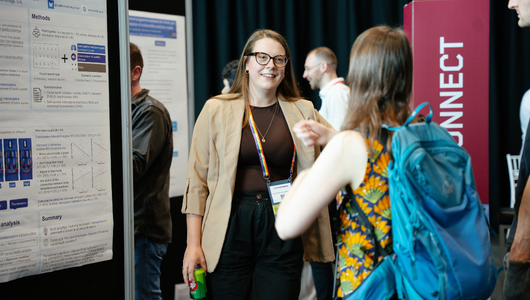
Poster Prizes: Prizes are open to postgraduate/PhD students and early career scientists (up to five years since graduating from highest qualification level; permanent faculty members are not eligible). Only presenting authors are eligible (presenting at the poster session, and first author on the abstract). Please tick the box if you do not wish to be considered for a poster prize.
Rapid-fire oral presentations: You have the option to put forward your abstract to the Programme Organising Committee for a short oral presentation. These are scheduled to take place in a rapid-fire session during the Festival, giving you the chance to raise awareness of your research and invite people to visit your poster. Poster talks will he 3 minutes long.
Declarations:
During abstract submission you will be asked to tick that you comply with the requirements including ethical standards.